” Whatever is rooted in greed, hatred, and delusion brings harm and bondage — abandon it; bow not to tradition, scripture, authority, or ritual, but only to what you have known to bring harm or to bring inner peace. “
Am reflecting on the Why? today! Because what is the point of me learning if it is not accompanied by reflection?
I notice how and Why my mind continually reaches for the new: a new movie, a new song, new clothes, new shoes, new ideas – always something else, always something next. It takes almost no time to acquire these things, yet so much time is avoided when it comes to sitting with what has already been learned, or what has not yet been understood properly.
How deeply do we really study a single quote from a great philosopher?
How often do we return to one essential idea; one that could quietly overturn our perspective, reshape our days, and alter the course of a week, a month, or even a year?
Do we pause long enough for that to happen? Or are we too busy chasing the next distraction; another image, another headline, another hollow urgency on a glowing screen?
I find myself asking: why can’t my mind stay with one significant thing? Why does it scatter so easily?
Why does it resist revisiting ideas, as though depth were a burden? Why does it feel a subtle pride after grasping something obvious, as if recognition itself were accomplishment?
I don’t yet know the answers. I am still investigating the flaw; if flaw is even the right word. Where does this tendency arise? How does it take shape? And how can it be recognized again and again, so that the mind might gradually learn the peace that follows sustained attention? This is the puzzle I am trying to understand, the puzzle itself.
When I began writing this post , my intention was simple: to be concise, to remain focused, to stay close to the reason for this reflection. Yet the mind moves as it does; remembering and drifting. Memories surfaced, some sweet and some painful, especially those tied to my birds. I felt the need to begin with sweetness, knowing how heavy the painful memories can be.

So I offer my gratitude, for the space to share their story, for the chance to speak of their distinct personalities, and for how they shaped each of my 365 days this past year. Looking back now, beyond the suffering I witnessed, I can say that the experience was, at the very least, deeply meaningful.
To write this honestly required reflection. It required sitting with discomfort rather than escaping it. And in that sitting, one question kept returning:
Click below to Continue Reading!
What is a delusional thought? How can I recognize it? And how can I meet it consistently?
Consistency feels essential and to be clearly mentioned here, because this struggle is not occasional, it is daily. And perhaps that, too, is part of the inquiry.
What I noticed afterward unsettled me. Many of you visited my site since the referenced post, far more than I expected. You read. You lingered. And yet, no one stepped into the conversation. No one engaged with the question I was openly struggling with: what is a delusional thought? Even after I admitted how lost I felt trying to navigate that word.
Now I understand why. It is not a pleasant thing to examine.
When I tried to analyze it honestly, my mind resisted. The discomfort was unmistakable. The silence that followed was not peaceful, it was loud. Almost threatening. My mind wanted to disengage entirely. Because somewhere beneath that resistance was an unspoken knowing: if I truly looked, I might find something real. And if I found something real, I would have to face it. And facing it would demand more! more effort, more solitude, more dedication, more deviation from familiar paths. It would require witnessing suffering without flinching, and returning to that witnessing consistently. My mind was not ready for that.
So I asked myself: how do I find the strength to steer this distracted ship? Where does the motivation come from to push through this fog of confusion and anticipation?
Then, I realized I needed to approach the inquiry gently, without alarming the mind. I reread my post. I reflected again. And then I returned to something simple: a definition. Not to collect knowledge, but to steady myself. This is what I arrived at, in my own words:
A delusion is an unshakable false belief, marked by absolute certainty and held strongly even when evidence contradicts it. More simply, a delusion is a thought disconnected from reality, fueled by ignorance or misunderstanding, and one that increases agitation and confusion rather than peace. Such misperception, left unseen, becomes a direct cause of suffering.
But definitions were not what I was after. I wanted something concrete. Something I could recognize in my own life. Something I could learn from directly, through experience rather than abstraction. So I looked outward, through my window, past the trees, listening to familiar sounds. I wasn’t looking for information. I was looking for memory. For an experience that mattered to me enough to anchor this inquiry in reality.
To simplify further, I asked: what do delusional thoughts actually do? From past learning, one answer surfaced clearly: they produce agitation, confusion, and regret. That was enough. I had a thread to follow.
When I traced it backward through memory, I found a familiar state;; an agitated, unmotivated mind, overwhelmed by emotion, struggling against circumstances that felt impossible to change at the time.
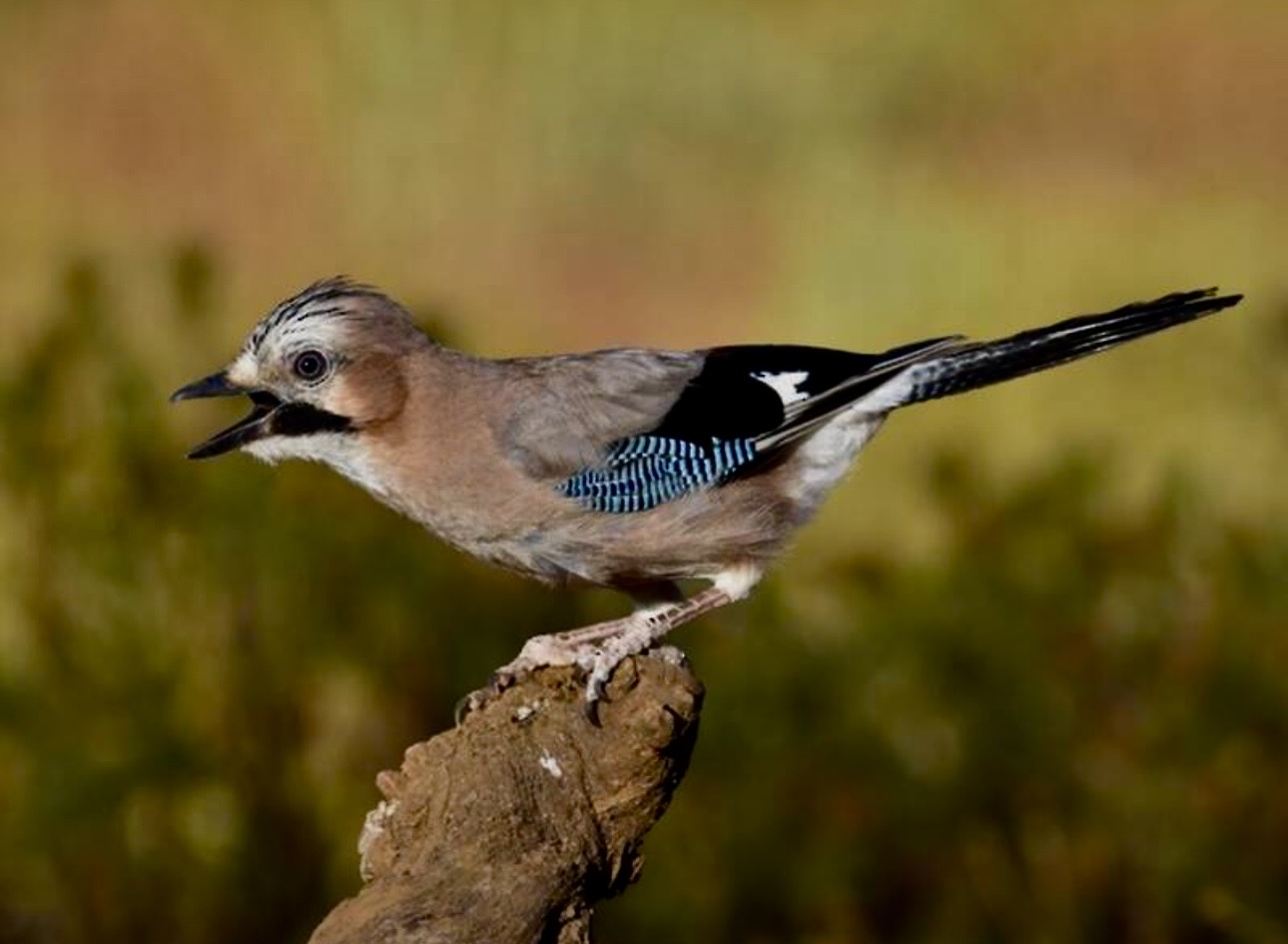
That was when I remembered how I first encountered scrub jays. It wasn’t pleasant.
I was already overwhelmed, learning how to feed birds on my deck. Seeds spilled everywhere. The wind made a mess of everything. Cleaning felt endless. Then the jays arrived; loud, territorial, chaotic, seemingly clashing with other birds, drawing crows, turning my quiet effort into disorder.
I quickly formed a strong belief and I strongly believed it: I cannot feed these birds. They were obnoxious. Disruptive. Too much to deal with.
I went online looking for validation, for ways to get rid of them. What I found startled me. Almost everyone seemed to hate scrub jays. The reasons were familiar: they’re loud, and they prey on unhatched eggs. I already knew the first. The second struck deeper than I expected.
And yet, when I paused, I saw the contradiction. Whether scrub jays prey on eggs or not was irrelevant to my life. I could do nothing about it. It was nature. And still, I couldn’t let the thought go. At the time, I didn’t understand why. Then I did something silly and small, almost trivial. I searched for what they liked. The answer was simple: peanuts. Fine, I thought. Peanuts.

That single realization, just-one-bag of peanuts? quietly dismantled the belief I had been so certain of. What followed in the months ahead was not chaos, but intimacy. Not disturbance, but relationship. The experiences that emerged from that moment were immense, tender, and unexpectedly blissful. Only later did I recognize it for what it was.
The agitation did not disappear when my perspective shifted. If anything, it grew louder. The scale of what lay ahead became suddenly visible, and the mind reacted in the most predictable way: this is too much. It felt impossible, unreasonable, even unwanted. The resistance was not irrational, it was practical, almost sensible. And yet, something in me could not turn away. I could not not feed them.
So I reduced the whole weight of it to one small, manageable act. One bag of peanuts. That single simplification became my first step into the wilderness. It carried a quiet reassurance: one thing, done today, can be enough. Change does not always arrive as resolve; sometimes it arrives as permission.
You might wonder how a perspective so fixed could shift so quickly? how something that felt overwhelming could be entered by doing something so small? I wondered the same. What made it possible was not discipline or conviction, but a motivation, unexpected and precise. I found one reason strong enough to steady the mind when it began to recoil.
If I feed this bird today, it does not have to wake up driven by hunger. It does not have to wake with the thought of killing, of preying on an unhatched egg or a fragile hatchling. It does not have to harm in order to survive. For one day, the weight of existence is eased; for the bird, and in that, for me as well. My mind can rest, quietly, in the small but profound knowing that I have done something that matters, that I have eased a life, even in this one small way.
That was enough. Not as a theory. Not as a moral stance. But as a reason the mind could accept quietly, without argument. And in that quiet acceptance, something real began.

Food for thought — pause and ponder!!
Will you? Can’t you?
What does it really take to make a change? Sometimes, all it takes is one small act! Here’s something to reflect on: real change doesn’t always require grand gestures.
One $15 bag of peanuts was all it took to ignite a full transformation—for me.
